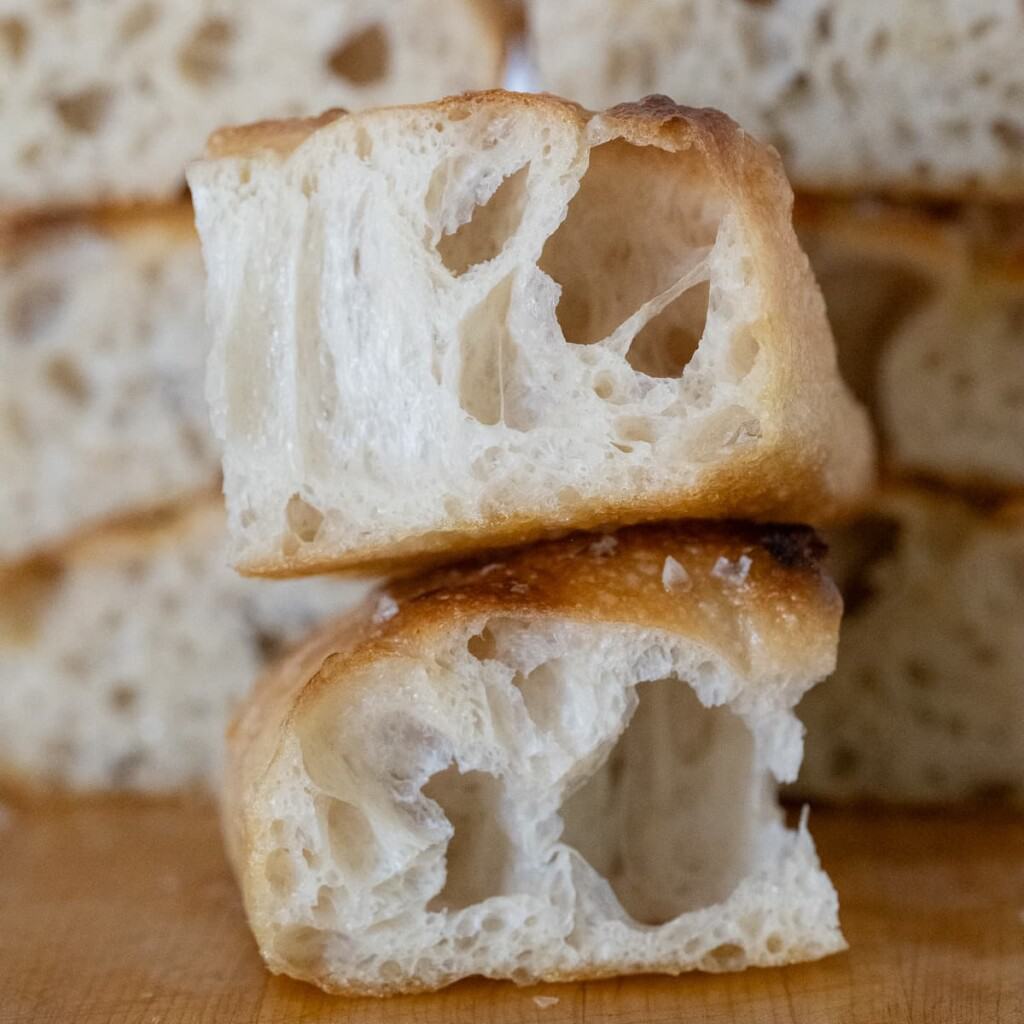
Easy No Knead Focaccia
Servings :8 servings
EQUIPMENT
- food scale (affiliate link)
INGREDIENTS
- 500 grams bread flour (affiliate link)
- 10 grams kosher salt (affiliate link) 2 teaspoons
- 8 grams instant yeast (affiliate link) 2 teaspoons
- 400 grams water room temperature
- 1 ½ tablespoons olive oil (affiliate link)
- coarse salt (affiliate link) Maldon flake salt
INSTRUCTIONS
- Combine the Ingredients. Add all the bread ingredients to a bowl. If you have a scale, weigh the ingredients directly into the bowl.500 grams bread flour, 10 grams kosher salt, 8 grams instant yeast, 400 grams water, 1 ½ tablespoons olive oil
- Mix the Dough. Mix the dough with a wooden spoon. The dough will be very wet and sticky.
- First Rise. Oil a large bowl. Add your dough to the oiled bowl and cover with plastic wrap or a large damp towel. We will be using the pull-and-turn method to develop gluten and large air pockets. Let the dough rest for 30 minutes. After 30 minutes, use hands moistened with water to pull one corner of the dough to the opposite side. Turn the bowl one-quarter, and repeat 3 more times. Recover the bowl and let it sit for another 30 minutes. You will repeat this process 3 times for a total of pull-fold-turns.
- Cold-proof. Make sure the top of the dough is slathered with a generous helping of olive oil. Cover the bowl tightly with plastic wrap. Place the bowl in the fridge for 12 hours (up to 3 days.)
- Second Rise. Remove the dough from the fridge and let it come to room temperature for one hour. Prepare a 9x13-inch baking pan. Generously oil a 9x13 baking pan. After one hour, gently dump the dough into the baking pan. Drizzle more olive oil onto the top of the dough. Cover the pan with plastic wrap and cover with a kitchen towel OR an inverted, rimmed baking sheet. Allow the bread to rise at room temperature for 3 to 4 more hours. You want to make sure you are getting a lot of large bubbles in the dough. [note 1]
- Dimple the dough. After 3 to 4 hours, drizzle the top of the dough with even more olive oil. Cover your fingertips in olive oil and press your fingertips into the surface to dimple the dough. You want to press gently and jiggle to encourage the air to rise to the surface of the dough.
- Preheat your oven: Set up a middle rack. Set the oven to convection bake and preheat the oven 500℉/260℃.
- Add your toppings to the top of the dough. Make sure the toppings are oiled so that they don't burn. See below for suggestions on the best toppings for focaccia bread.coarse salt
- Bake for 25-30 minutes until golden brown. Rest the bread for 10 minutes in the pan and then transfer it to a baking rack to cool. Cool for 15 minutes before slicing.
RECIPE TIPS
- If the dough seems like it's not rising or you aren't getting many large bubbles, you might want to find a warmer place to proof the dough. You can do this by warming your oven to the lowest setting and then turning it off. Place the covered pan in the warm oven.
Yummy Focaccia Topping Variations
-
- Flakey salt. This is the most straightforward topping to add to focaccia. I use flake salt no matter what other toppings are added. Use a salt like Maldon or Fleur de Sel.
-
- Rosemary Focaccia. Fresh rosemary is a classic topping. If desired, you can use fresh rosemary alone or combine it with roasted garlic and flakey salt.
-
- Green Onions. Fresh green onions are another classic topping.
-
- Tomato focaccia. Fresh tomatoes caramelized on top of focaccia when it's baking and give it a sweet element that tastes amazing with the olive oil and a little salt.
-
- Olives. Juicy olives are the perfect addition to this rustic bread. You can use kalamata olives, cerignola, Niçoise, or Manzanilla. Check out this post to find more olives that are worth trying.
-
- Caramelized onions and tart apples. I love this combo on bread. I also like to add a little gruyere to the top.
-
- Figs and lardons with thyme. This combination is savory and sweet. Drizzle with honey before serving.
-
- Proscuitto and peaches. This is a classic, savory, sweet combination. Fresh thyme is a great addition.
-
- Potato and rosemary. Slice potatoes very thin and top the bread with them. Add rosemary and, of course, olive oil and salt before baking.
-
- Basil Pesto. Pesto can be folded into the focaccia dough during the pull-and-fold step. It can all be added to the top.
NUTRITION
Serving: 1 slice | Calories: 306kcal | Carbohydrates: 46g | Protein: 8g | Fat: 10g | Saturated Fat: 1g | Sodium: 489mg | Fiber: 2g | Sugar: 0.2g | Calcium: 12mg | Iron: 1mg